
SUMMARY
Auction finance is a short-term funding solution that enables property buyers to complete purchases within the strict 28-day deadline imposed by auction houses. When the hammer falls at auction, the buyer immediately exchanges contracts and must complete the purchase within 28 days - a timeline that traditional mortgages cannot meet. Auction finance provides the speed, certainty, and reliability needed to honour legally binding auction contracts, making it essential for investors, developers, and property traders acquiring non-standard assets that require refurbishment or development.

Auction finance is a specialised short-term loan designed specifically for property purchases at auction. Unlike conventional mortgages that typically take 4-12 weeks to process, auction finance can be arranged within 48-72 hours after winning a bid, ensuring buyers meet the mandatory 28-day completion deadline.
The properties purchased with auction finance are generally not standard, vanilla, residential assets. They typically require asset management, refurbishment, or redevelopment before realizing their true market value. This includes properties that are:
In need of substantial renovation or modernization
Unmortgageable through traditional lenders, perhaps, lacking a kitchen or bathroom.
Below market value due to condition or circumstances
Suitable for development or conversion
Investment properties being acquired for portfolios
Key characteristics of auction finance:
Loan amounts: Typically £50,000 to £5 million
Loan-to-Value (LTV): Usually 60-75% of property value
Interest rates: Generally 0.75% to 1.1% per month
Term length: 1-24 months, with most lasting 6-12 months
Approval speed: 48 hours from complete application
Understanding how auction finance works requires knowing both the pre-auction preparation and post-auction execution phases.
Before the Auction: Pre-Approval and Due Diligence
Step 1: Identify target properties (7-14 days before auction): Buyers review upcoming auction catalogues, identify suitable lots, and conduct physical property viewings to assess condition, potential refurbishment costs, and realistic end values.
Step 2: Review legal documentation (5-10 days before auction): Download and thoroughly examine the legal pack for each target property. This includes title deeds, local authority searches, lease details (if applicable), and any legal restrictions or covenants.
Step 3: Contact lender for pre-approval (3-7 days before auction): Approach an auction finance lender with property details, purchase strategy, and intended exit plan (refinance, sell, or rent). The lender conducts a preliminary assessment to determine whether the deal is viable.
Step 4: Receive Agreement in Principle (2-5 days before auction): If the lender is satisfied with the property quality, legal position, and buyer's exit strategy, they issue an indicative agreement or Decision in Principle. This gives the buyer confidence to bid, knowing funding will be available if successful.

After Winning: Completion Within 28 Days
Day 0: Pay the 10% deposit immediately: The moment you win at auction, contracts are exchanged. You must pay a non-refundable 10% deposit on the spot (or within 24 hours for online auctions). The legally binding contract starts the 28-day countdown to completion.
Days 1-3: Instruct property valuation: The lender immediately instructs an independent RICS surveyor to conduct a formal valuation. This typically takes 2-3 days to complete and report back.
Days 1-7: Begin legal work: Your solicitor starts conveyancing work while the lender's legal team reviews all documentation. Because much of this was prepared pre-auction, the process moves significantly faster than traditional transactions.
Days 5-10: Formal loan approval: Once the valuation report confirms the property value and the legal review finds no issues, the lender issues formal loan approval with final terms.
Days 10-25: Final underwriting and documentation: Both parties complete remaining checks, finalize loan documentation, and prepare for fund release. The solicitor ensures all legal requirements are met for completion.
Day 28 (or before): Funds released and completion: The lender transfers funds to your solicitor, who completes the purchase. You receive the keys and become the legal owner. Missing this deadline results in forfeiting your 10% deposit and potential legal action from the seller.
Tim is an experienced property investor who regularly purchases at auction. His approach demonstrates best practice for auction finance users.
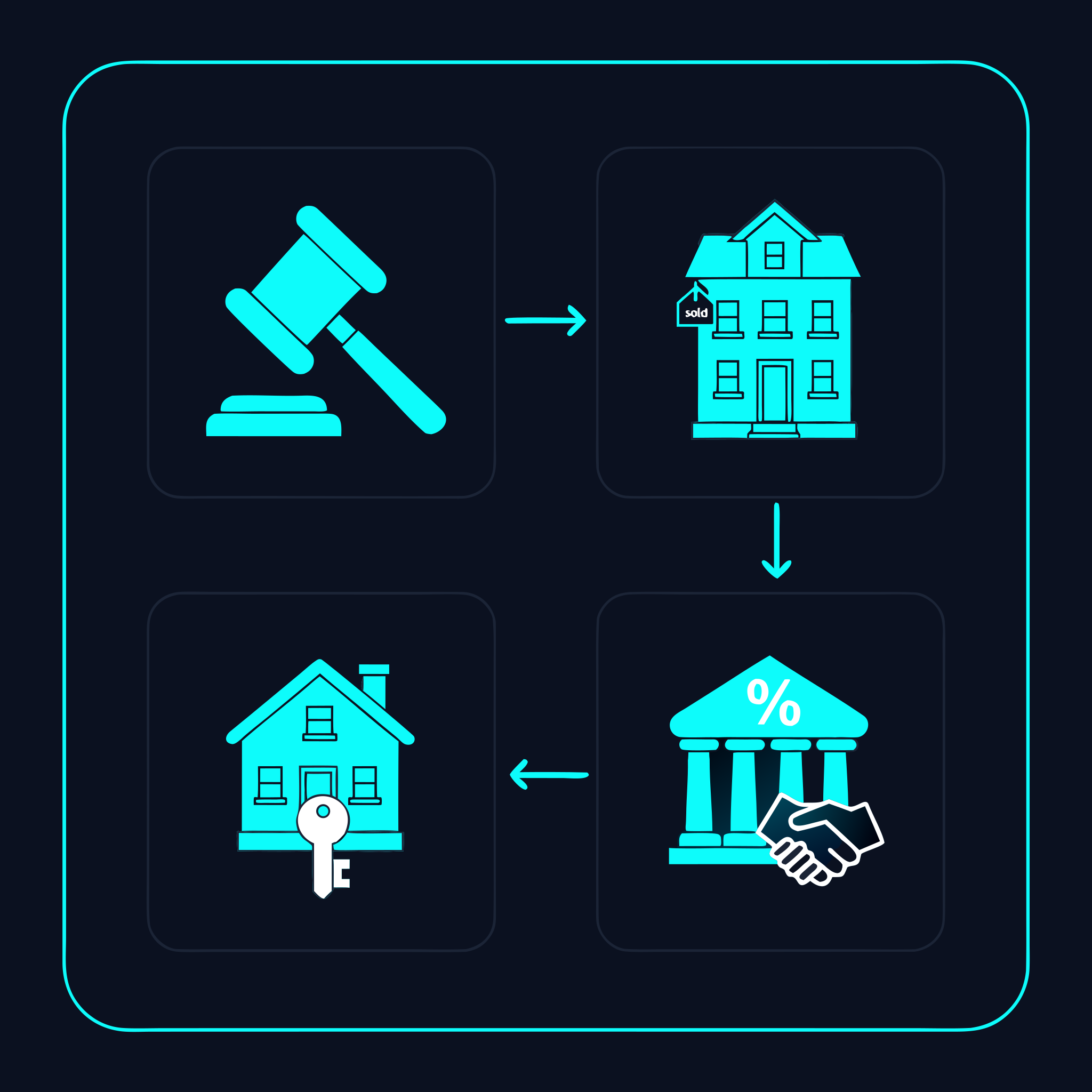
Pre-auction preparation:
Tim identifies two renovation properties at an upcoming online auction. He views both properties in person, noting structural condition, required works, and potential end values after refurbishment. He reviews their legal packs thoroughly, checking for any title issues, planning restrictions, or encumbrances.
Tim contacts his auction finance lender with full property details, including:
Purchase price estimate: £180,000
Refurbishment budget: £40,000
Gross Development Value (GDV): £280,000
Exit strategy: Refinance onto a buy-to-let mortgage after renovation
The lender confirms they would support the purchase at 70% LTV (£126,000), subject to valuation. This gives Tim confidence to bid up to £180,000.
Auction day:
Tim successfully wins one property at £175,000. He immediately pays the £17,500 deposit (10%) electronically. The 28-day completion clock starts.
Post-auction execution:
Day 1: Tim notifies his lender of the successful bid with final purchase price
Day 2: Independent valuation instructed
Day 5: Valuation confirms £175,000 value; lender approves £122,500 loan (70% LTV)
Days 5-20: Legal work and documentation completed
Day 24: Funds released; Tim completes the purchase
Tim brings £52,500 of his own funds (£17,500 already paid as deposit + £35,000 at completion) plus the £122,500 loan. He now owns the property and can begin refurbishment, planning to refinance within 6 months.
Key Success Factors:
Preparation before bidding gave Tim confidence and speed
Pre-approval meant no surprises after winning
Clear exit strategy satisfied lender requirements
Experience with auction timelines ensured smooth execution
Traditional mortgages are fundamentally incompatible with auction timelines for several reasons:
Standard mortgage timeline: 4-12 weeks minimum
Full application processing: 5-7 days
Property valuation: 3-5 days
Underwriting and credit checks: 7-10 days
Mortgage offer issued: 14-21 days from application
Legal work and searches: 14-28 days
Total timeline: 28-42 days (often longer)
Auction completion deadline: 28 days maximum
Even in the fastest scenarios, traditional mortgages rarely complete in less than 4 weeks. Auction houses do not grant extensions, and missing the deadline results in:
Forfeiture of the 10% deposit
Breach of contract, potentially leading to legal action
Being banned from future auctions with that auction house
Damage to reputation in the property investment community
Property condition barriers:
Most auction properties are unmortgageable through standard lenders because they:
Require substantial structural repairs
Lack basic amenities (kitchen, bathroom, heating)
Have Japanese Knotweed or subsidence issues
Are uninhabitable in current condition
Have non-standard construction methods
Auction finance lenders specialize in valuing properties based on their potential post-refurbishment value, not just current condition.
Bridging loans for auction purchases
The most common form of auction finance is a regulated or unregulated bridging loan:
Regulated bridging loans apply when:
The property will become your main residence, or
You're buying a property for a family member to live in
These offer consumer protections but have slightly longer approval times (5-7 days typically).
Unregulated bridging loans apply when:
Purchasing investment properties
Buying properties for renovation and resale
Acquiring commercial premises
These can be approved in 48-72 hours and offer more flexibility for complex cases.
Development finance for auction properties
For properties requiring extensive renovation or conversion, development finance may be more suitable:
Funds released in stages as work progresses
Higher LTV possible (up to 75% of GDV in some cases)
Longer terms available (12-24 months)
Interest can be rolled up or serviced monthly
Refurbishment finance
Refurbishment finance is specifically designed for auction properties needing modernization:
Combined purchase and refurbishment funding
Typically 70-75% of purchase price plus 100% of refurb costs
Released in tranches as work is completed and inspected
Exit onto long-term mortgage or sale
Understanding the full cost structure is essential for calculating auction purchase viability.
Interest rates
Monthly interest rates: 0.75% to 1.1% per month (9% to 15% annually)
Factors affecting your rate:
Loan-to-Value ratio (lower LTV = lower rate)
Property type and condition
Your experience as a borrower
Exit strategy strength
Loan term length
Example cost calculation:
Property purchase: £200,000
Loan amount: £140,000 (70% LTV) Monthly interest: 0.95%
Term: 6 months
Monthly interest cost: £1,330 Total interest (6 months): £7,980
Arrangement fees
Most lenders charge an arrangement or facility fee:
Typically 1% to 2% of loan amount
Usually deducted from loan proceeds
Covers underwriting, legal, and administration costs
Example: £140,000 loan × 2% = £2,800 arrangement fee
Additional costs
Valuation fee: £300-£2,000 depending on property value and complexity
Legal fees (lender's): £1,500-£5,000 (you pay the lender's legal costs)
Legal fees (your own): £1,000-£2,000 for conveyancing
Exit fees: Some lenders charge 0.5-1% exit fee on redemption (check terms carefully)
Total cost example
Property: £200,000 Loan: £140,000 (70% LTV) Term: 6 months
Interest (6 months): £7,980
Arrangement fee (2%): £2,800
Valuation: £600
Lender's legal: £1,200
Your legal: £1,500
Exit fee (1%): £1,400
Total finance costs: £15,480 (7.7% of property value)
Your own funds required: £60,000 deposit + £15,480 costs = £75,480 total
Lenders assess auction properties on a case-by-case basis, with LTV determined by:
Standard auction property: 65-75% LTV
Properties in reasonable condition
Clear exit strategy
Experienced borrower
Higher-risk auction property: 55-65% LTV
Significant refurbishment needed
First-time auction buyer
Complex legal situation
Prime property or strong borrower: 70-75% LTV
Good condition property
Proven track record
Solid financials and exit plan
Development projects: Up to 75% of Gross Development Value (GDV)
Professional developer
Strong development appraisal
Pre-sold or pre-let property
Your LTV directly impacts how much deposit you need:
£200,000 property at 65% LTV = £130,000 loan = £70,000 deposit needed
£200,000 property at 75% LTV = £150,000 loan = £50,000 deposit needed
Speed of approval and completion
Decision in Principle: 24-48 hours from initial enquiry with property details
Full approval: 48-72 hours after valuation completion
Funds available: 7-21 days from formal application (typically 10-14 days)
This speed is possible because auction finance lenders:
Specialise in fast-track underwriting
Employ in-house valuation teams
Use streamlined legal processes
Focus on asset security rather than complex affordability assessments
Have dedicated auction finance departments
Certainty and confidence
Having pre-approval before bidding provides:
Confidence to bid to your maximum price without hesitation
Certainty that funding will be available after winning
Protection against losing your deposit due to funding failure
Competitive advantage over unprepared bidders
Experienced auction buyers report that 95%+ of pre-approved auction finance applications complete successfully when the property matches the initial assessment.
Flexibility for non-standard properties
Auction finance unlocks opportunities that traditional mortgages cannot:
Properties without kitchens or bathrooms
Buildings requiring structural repairs
Properties with short leases (under 70 years)
Uninhabitable properties
Properties sold with sitting tenants
Ex-local authority properties
Non-standard construction (concrete, timber frame)
Clear structure and timeline
Auction transactions follow predictable, time-bound processes:
All parties work to the same fixed deadline
No chain complications
No seller withdrawal risk (contract is legally binding on both sides)
Defined milestones make project planning straightforward
Access to below-market-value properties
Auction properties often sell at 15-30% below market value because:
They require work that most buyers cannot finance
Sellers need fast sales and accept auction discounts
Traditional buyers cannot compete due to 28-day deadline
Competition is limited to cash buyers and auction finance users
This discount provides immediate equity and profit potential for investors and developers.
Ideal candidates for auction finance include:
Experienced property investors who:
Understand property valuation and renovation costs
Have completed previous auction purchases or refurbishment projects
Can accurately assess properties and calculate returns
Have contingency funds for unexpected costs
Property developers who:
Acquire sites for residential or commercial development
Specialize in converting or extending properties
Have proven track records of project completion
Can demonstrate development experience to lenders
Portfolio landlords who:
Are expanding their rental property portfolios
Seek below-market-value acquisition opportunities
Can refinance onto buy-to-let mortgages after light refurbishment
Understand rental yields and property management
Property traders and flippers who:
Buy, renovate, and sell properties for profit
Have the skills (or contractor relationships) to manage refurbishments
Can accurately forecast end values and profit margins
Work with quick turnaround timelines (3-12 months)
Who should consider alternatives
Auction finance is less suitable for:
First-time buyers seeking a home to live in immediately (auction properties usually require work and don't suit owner-occupation until completed)
Inexperienced investors without previous property projects (the compressed timeline and non-standard properties create significant risk if you misjudge costs or values)
Buyers without adequate contingency funds (unexpected issues frequently arise with auction properties; you need financial reserves beyond the deposit)
Those unable to service the monthly interest (while interest can often be rolled up, having cash flow to cover it provides important flexibility)
Experience and preparation requirements
Successful auction buyers typically have:
Previous experience with property refurbishment or development (at least 1-2 completed projects)
Existing relationships with reliable contractors and tradespeople
Understanding of planning permission and building regulations
Ability to quickly assess property condition and renovation costs
Financial reserves of at least 20-30% beyond the minimum deposit
A clear, realistic exit strategy (refinance timeline or sale plan)
Exit strategies: Repaying your auction finance
Auction finance is a short-term product. You must have a credible plan to repay the loan within the agreed term (typically 6-12 months).
Refinancing to a long-term mortgage
Most common exit strategy (60-70% of cases): After purchasing and refurbishing the property, you refinance onto a standard residential or buy-to-let mortgage:
Timeline:
Month 1: Purchase and secure property
Months 2-5: Complete refurbishment and obtain Building Control certification
Month 6: Property revalued at improved value
Month 6-7: Complete remortgage application
Month 7-8: New mortgage completes; bridging loan repaid
Requirements:
Property must be in mortgageable condition (habitable, with functioning kitchen, bathroom, heating)
Valuation must support the new loan amount
You must meet mortgage affordability criteria
New lender must be satisfied with property standards
Example:
Original purchase: £175,000 Refurbishment cost: £30,000 New valuation: £250,000 Remortgage at 75% LTV: £187,500 Repay bridging loan: £122,500 Your equity released: £65,000 (your refurb costs and profit)
Sale on the open market
Second most common strategy (25-30% of cases): Buy, renovate, and sell for profit (property flipping):
Timeline:
Months 1-4: Refurbishment
Month 4: Market the property
Month 5-6: Exchange and complete sale
Month 6: Bridging loan repaid from sale proceeds
Profit calculation example:
Purchase price: £175,000 Refurbishment: £30,000 Finance costs: £12,000 Legal and sale costs: £8,000 Total costs: £225,000
Sale price: £280,000 Gross profit: £55,000 Return on investment: 24% in 6 months
Rental Income (Less Common)
Some borrowers service the monthly interest from rental income while completing light refurbishment, then refinance:
Serviced bridging loans:
Pay interest monthly rather than rolling it up
Reduces total interest costs
Allows property to generate income immediately
Suitable for tenanted auction purchases or properties requiring minimal work
Qualification criteria: What lenders look for
Property assessment
Lenders evaluate:
Property type and location (residential, commercial, mixed-use)
Current condition and marketability
Required work scope and cost
Post-work valuation (current value and GDV)
Comparable sales in the area
Planning status and permitted use
Properties that strengthen applications:
Located in strong rental or sale markets
Requiring cosmetic rather than structural work
With clear planning permission already in place
In areas with high demand and recent comparable sales
Borrower assessment
Credit history: While less stringent than traditional mortgages, lenders review credit reports. Serious adverse credit (bankruptcy, CCJs) may require explanation, but minor issues are often acceptable.
Income verification: For regulated bridging loans, full income verification is required. For investment properties (unregulated), income is less critical than the asset itself.
Property experience: First-time auction buyers may need to demonstrate:
Previous property ownership
Refurbishment experience (even on own homes)
Strong professional support (experienced contractor, project manager)
Higher deposits (60-65% LTV rather than 70-75%)
Deposit and reserves: Expect to provide:
Minimum 25-30% deposit (to achieve 70-75% LTV)
Proof of funds for deposits and costs
Evidence of contingency reserves (typically 10-15% of project costs)
Exit strategy validation
Lenders require credible exit plans:
For refinance exits:
Evidence that you'll meet mainstream mortgage criteria
Realistic property valuation post-work
Sensible timeline for work completion (most refurbs take longer than expected)
For sale exits:
Market analysis showing realistic sale prices
Sufficient profit margin (minimum 20-25% profit required)
Marketing strategy and timeline
Red flags that concern lenders:
Unrealistic end valuations (over-optimistic by 20%+)
Insufficient contingency for delays or cost overruns
Complex planning requirements without permission in place
Poor local market conditions limiting sale/rental demand
How the auction landscape has evolved
The shift to online auctions
Most property auctions now operate entirely online through digital platforms. This fundamental change has transformed the auction process:
Traditional in-room auctions:
Fixed auction date and physical location
Bidding ends when hammer falls
Immediate atmosphere and competitive tension
Limited geographical reach
Modern online auctions:
Bidding windows lasting 24-48 hours (or longer)
Accessible from anywhere
Extended bidding if bids come in near deadline
National and international participation
Implications for auction finance:
Faster deposit payments: Electronic deposits must be paid within 24 hours rather than on the spot
Remote due diligence: All property information accessed digitally; physical viewings arranged separately
Digital legal packs: Downloaded PDFs replace paper documentation
Faster communication: Lenders and buyers coordinate entirely via email and phone
Greater competition: More bidders can participate, potentially driving prices higher
Increased accessibility
Online platforms have democratised auction access:
Catalogue browsing: View hundreds of properties nationwide from home
Flexible viewing: Book viewing appointments directly with agents or auction houses
Automated alerts: Receive notifications for properties matching your criteria
Bid tracking: Monitor competing bids in real-time
Post-auction sales: Properties that don't sell at auction often available immediately after
Compressed preparation timeline
The accessibility of online auctions means:
Properties can be listed with shorter notice periods
Bidding can begin almost immediately after listing
Buyers must complete due diligence faster
Lender pre-approval is more critical than ever
Best practice: Begin finance discussions 7-10 days before auction date, not 2-3 days.
Comparison: Auction finance vs. traditional mortgages
Feature | Auction finance | Traditional mortgage |
|---|---|---|
Approval timeline | 48-72 hours | 2-6 weeks |
Completion window | 7-21 days | 28-56 days (flexible) |
Property condition | Any condition accepted | Must be habitable and mortgageable |
Interest rate | 0.75-1.1% per month | 4-6% per year |
Loan term | 1-24 months | 5-35 years |
LTV ratio | 60-75% typically | 75-95% typically |
Arrangement fees | 1.5-2% | £0-£2,000 flat fee |
Income verification | Light touch (asset-focused) | Full affordability assessment |
Purpose | Short-term, high-speed funding | Long-term property ownership |
Exit strategy required | Yes (refinance or sale plan) | No (intended as permanent funding) |
Best for | Auction purchases, refurb projects | Standard property purchases with time |
Choosing the right auction finance lender
What to look for in a lender
Proven auction finance experience: Lenders specializing in auction purchases understand the urgency and property types involved. Generic bridging lenders may not deliver the required speed.
Speed of decision-making: Check average approval times and completion records. Ask for references from previous auction clients.
Transparent fee structure: All fees, rates, and charges should be clearly explained upfront with no hidden costs emerging later.
In-house valuation capability: Lenders with their own valuation teams process applications faster than those relying on external panels.
Flexible lending criteria: For non-standard properties or first-time auction buyers, you need lenders willing to assess deals on individual merit rather than rigid criteria.
Relationship approach: The best lenders provide dedicated account managers who guide you through the process rather than call-centre handling.
Questions to ask potential lenders
What is your average time from application to funds available?
What percentage of your pre-approved auction finance applications complete successfully?
Do you handle valuations in-house or through external panels?
What is your LTV range for properties requiring significant refurbishment?
Are there any exit fees or early repayment charges?
Can you provide references from recent auction finance clients?
What happens if the valuation comes in lower than expected?
Do you offer retention facilities for refurbishment funding?
Frequently Asked Questions About Auction Finance
What is the typical interest rate for auction finance?
Auction finance interest rates typically range from 0.75% to 1.1% per month (equivalent to 9-15% annually). Your specific rate depends on the loan-to-value ratio, property type, your experience as a borrower, and the strength of your exit strategy. Lower LTV loans (60-65%) generally secure lower rates, while higher-risk properties or first-time auction buyers may pay rates at the higher end. These rates are significantly higher than traditional mortgages but reflect the speed, flexibility, and short-term nature of the product.
How much can I borrow with auction finance?
Most auction finance lenders offer loans between £50,000 and £5 million, with loan-to-value ratios typically between 60% and 75% of the property's value. Some specialist lenders can arrange larger facilities for experienced developers or portfolio purchases. The exact amount you can borrow depends on the property valuation, your deposit size, the refurbishment scope, and your exit strategy. For development projects, lenders may advance up to 80% of the Gross Development Value (GDV), released in stages.
What types of properties qualify for auction finance?
Auction finance is specifically designed for non-standard properties that traditional lenders won't mortgage, including:
Properties requiring substantial refurbishment or modernization
Uninhabitable properties without basic amenities
Buildings with structural issues needing repair
Properties with short leases (under 70 years)
Non-standard construction (concrete, timber frame, ex-local authority)
Commercial premises or mixed-use buildings
Properties sold with sitting tenants
Land with planning permission for development
Standard residential properties in good condition can also be financed this way if purchased at auction.
How long does auction finance approval take?
Decision in Principle: 24-48 hours after submitting property details and your purchase plan
Formal approval: 48-72 hours after the valuation is completed
Funds available for completion: 7-21 days from formal application, typically 10-14 days
The key to meeting the 28-day completion deadline is obtaining pre-approval before the auction. With an Agreement in Principle in place, post-auction processing is significantly faster because much of the due diligence is already complete.
What happens if I can't complete within 28 days?
Failing to complete within the contractually agreed deadline (usually 28 days) has serious consequences:
Forfeiture of deposit: You lose your entire 10% deposit (typically £10,000-£50,000+)
Breach of contract: The seller can pursue legal action for losses and damages
Auction house penalties: You may be banned from bidding at future auctions with that house
Reputation damage: Word spreads in the property investment community
Some auction houses may grant a short extension (2-7 days) in exceptional circumstances, but this is rare and usually incurs substantial penalty fees. The best protection is working with experienced auction finance lenders who have proven track records of meeting completion deadlines.
Do I need a deposit beyond the 10% auction deposit?
Yes. The 10% auction deposit is only the initial payment at exchange. You need additional funds to complete the purchase:
Total deposit required = Property price × (1 - LTV ratio)
Example:
Property price: £200,000
LTV ratio: 70% (you're borrowing 70%)
Total deposit needed: £60,000 (30% of £200,000)
You've paid £20,000 at auction (10%)
You need an additional £40,000 at completion
Plus you need funds to cover:
Lender arrangement fees (1.5-2% of loan)
Your legal costs (£1,000-£2,000)
Monthly interest (if servicing rather than rolling up)
Refurbishment costs (if not including in the loan)
Contingency funds (recommended 10-15% buffer)
Can I include refurbishment costs in the loan?
Yes, many auction finance lenders offer combined purchase and refurbishment loans:
Structure:
Initial drawdown covers property purchase
Subsequent releases fund refurbishment in stages
Funds released as work is completed and inspected
Typical terms:
70-75% of purchase price
Plus 100% of refurbishment costs (up to an agreed maximum)
Overall LTV typically capped at 75% of GDV
Example:
Purchase price: £150,000 Refurbishment budget: £40,000 Gross Development Value: £240,000
Loan structure:
Purchase advance: £105,000 (70% of £150,000)
Refurb facility: £40,000 (100% of works)
Total loan: £145,000
Your deposit: £45,000 + fees
Overall LTV: £145,000 ÷ £240,000 = 60% of GDV
What documentation do I need to provide?
For pre-approval (before auction):
Property details and auction catalogue entry
Legal pack (title documents, searches, seller's information)
Your purchase plan and exit strategy
Proof of deposit funds
ID and proof of address
Basic financial information (bank statements, income overview)
For formal application (after winning):
Completed application form
Comprehensive financial statements (3-6 months bank statements)
Proof of income (if regulated loan)
Details of your solicitor
Refurbishment schedule and costings (if applicable)
Credit check authorization
Developer CV or track record (for development finance)
Having these prepared before bidding dramatically speeds up the post-auction process.
How quickly can I refinance after purchasing?
Most mainstream mortgage lenders require:
Minimum ownership period: 6 months from completion (some accept 3 months)
Completed refurbishment: Property must be in mortgageable condition with all work signed off
Formal revaluation: Independent RICS valuation at the improved value
Seasoning requirements: Some lenders have "title seasoning" rules requiring 6-12 months ownership before lending
Planning your timeline:
Month 1: Purchase complete
Months 1-4: Refurbishment works
Month 4: Building Control sign-off
Month 5: Apply for remortgage
Month 6-7: New mortgage completes
Always build buffer time into your exit strategy. Most refurbishment projects take 20-30% longer than planned.
Are there alternatives to auction finance for auction purchases?
Cash purchase: If you have sufficient liquid funds, buying outright eliminates finance costs and provides the fastest, simplest route. You can then arrange any desired mortgage afterwards without time pressure.
Joint venture partners: Partnering with other investors who provide funding in exchange for profit share. This avoids interest costs but requires sharing returns.
Private loans: High-net-worth individuals or family members may provide short-term loans, though interest rates are often similar to commercial lenders.
Developer finance: For extensive projects, specialist development finance provides longer terms and stage releases, though approval takes longer.
However, for most investors without substantial cash reserves, auction finance remains the only practical solution for meeting the 28-day completion deadline on auction properties. The alternatives either take too long (development finance), aren't available (cash), or are difficult to arrange reliably (private funding).
Using an auction finance calculator
An auction finance calculator provides quick indicative figures for planning your auction bids:
What calculators show you
Loan amount: Based on property value and LTV ratio
Monthly interest costs: Using the estimated interest rate
Total borrowing costs: Fees, interest, and charges over the loan term
Your required deposit: The equity you need to bring to the transaction
Example Calculation
Property purchase price: £200,000
LTV: 70%
Interest rate: 0.95% per month
Loan term: 6 months
Arrangement fee: 2%
Calculator output:
Loan amount: £140,000
Monthly interest: £1,330
Total interest (6 months): £7,980
Arrangement fee: £2,800
Estimated legal/valuation: £3,000
Total finance cost: £13,780
Your deposit required: £60,000
Your additional funds needed at completion: £53,780
Limitations of calculators
Calculators provide estimates only and cannot replace full underwriting:
Actual interest rates depend on full property and borrower assessment
Additional fees may apply based on property complexity
Your specific LTV may differ based on property condition
Exit fees aren't always included in standard calculators
Refurbishment costs aren't factored into basic calculators
Best use: Use calculators to quickly assess whether a property fits your budget and to compare multiple auction opportunities before committing to viewings and full due diligence.
Key risks and how to mitigate them
Risk 1: Unforeseen refurbishment costs
The risk: Properties sold at auction often have hidden issues (structural problems, damp, electrical faults) that aren't apparent during brief viewings. Costs can spiral beyond initial estimates.
Mitigation:
Commission a professional building survey before bidding (£500-£1,500 but invaluable)
Always add 20-30% contingency to refurbishment budgets
Work with experienced contractors who can assess properties with you
Review the legal pack for any structural survey reports
Risk 2: Overestimating end value
The risk: Your exit strategy relies on refinancing or selling at a predicted value. If the market falls or your assessment was too optimistic, you cannot repay the loan.
Mitigation:
Use conservative valuation estimates (recent sold comparables, not asking prices)
Consult local estate agents for realistic price opinions
Aim for minimum 25-30% profit margin for flips
Target properties where existing use value alone justifies the price
Risk 3: Delays in Work Completion
The risk: Refurbishment takes longer than planned, pushing beyond your loan term and incurring extension fees or preventing timely refinancing.
Mitigation:
Build realistic timelines (most projects take 50% longer than ideal scenarios)
Arrange loans with 9-12 month terms even if planning 6-month projects
Use contractors with proven track records and availability
Start planning permission or Building Control notifications immediately after purchase
Risk 4: Legal or title issues
The risk: The legal pack reveals issues that delay completion, prevent refinancing, or reduce property value (restrictive covenants, boundary disputes, access rights).
Mitigation:
Review legal packs with a qualified solicitor before bidding
Identify potential issues early and assess their impact
Factor resolution costs and time into your plan
Walk away from properties with insurmountable legal problems
Risk 5: Unable to secure refinancing
The risk: After completing your project, mainstream lenders refuse to refinance, leaving you unable to exit the bridging loan.
Mitigation:
Speak with remortgage brokers before purchasing to confirm criteria
Ensure your financial profile meets standard mortgage requirements
Complete all work to Building Control standards with proper certification
Allow 6+ months ownership for "title seasoning" requirements
Recommendations for auction finance success
1. Start preparation early: Begin lender conversations 7-14 days before auction day, not afterwards.
2. Obtain formal pre-approval: An Agreement in Principle gives you confidence to bid and speeds post-auction processing dramatically.
3. Be conservative in your numbers: Underestimate end values, overestimate costs, and allow extra time. Tight margins leave no room for the unexpected issues that always arise.
4. Build strong professional relationships: Regular auction buyers develop relationships with lenders, solicitors, surveyors, and contractors who understand their approach and respond quickly.
5. Know your exit before you enter: Never bid without a clear, realistic plan to repay the loan. Hoping something will work out is not a strategy.
6. Inspect properties thoroughly: Brief viewing slots aren't sufficient. Return multiple times, bring contractors, commission surveys on expensive purchases.
7. Read legal packs completely: Don't rely on summaries. Read every page or pay a solicitor to review them. Missing a crucial clause costs money.
8. Maintain adequate reserves: Have contingency funds beyond the minimum deposit. Properties always cost more than planned.
9. Track your numbers precisely: Know your maximum viable bid price accounting for all costs, desired profit, and realistic end value. Stick to it when auction excitement builds.
10. Learn from every purchase: Even experienced investors review what went well and what could improve. Each auction teaches lessons for the next.