
SUMMARY
Property development finance is a specialised structured loan that funds ground-up construction projects from land acquisition through to completion. It typically covers up to 70% of gross development value (GDV) or 90% of total project costs, with funds released in tranches tied to construction milestones. Loans run 12 to 24 months, cost 7% to 12% per annum plus arrangement and exit fees of 1% to 2%, and are repaid via sale of completed units or refinance onto a long-term mortgage. Security is typically a first charge over the site, a debenture over the borrowing SPV, and a personal guarantee from the shareholding directors.

Property development finance is a structured funding solution specifically designed for building new properties from the ground up. It provides capital to acquire land and complete construction of residential or commercial buildings, with repayment typically occurring through sale of the completed units or refinancing onto a long-term mortgage.
This finance type differs fundamentally from standard mortgages, which require a completed, habitable property. Development finance instead provides structured funding throughout the construction phase, supporting projects from initial land purchase through planning, construction and final completion.
Key characteristics:
Term length: Typically 12 to 24 months depending on project complexity
Funding structure: Staged drawdowns tied to construction milestones
Security: First charge over the development site, fixed and floating charge over the borrowing SPV, and personal guarantee from the shareholding directors
Exit routes: Sale of completed units or refinance to an investment or commercial mortgage
Borrower profile: Experienced developers, builders and property investors
Most commonly used for:
Ground-up residential developments (houses, apartments, multi-unit schemes)
New-build commercial properties (offices, retail units, industrial buildings)
Land subdivision and infrastructure projects
Conversion projects requiring substantial structural work
The three key numbers that define your loan:
1. Gross development value (GDV): The estimated market value of your completed project. For a four-unit residential scheme where each house sells for £350,000, your GDV is £1,400,000.
2. Total development costs (TDC): The complete cost to deliver the project, including land acquisition, build costs, professional fees, statutory fees, finance costs and contingency (typically 10% of build costs).
3. Loan-to-value (LTV) and loan-to-cost (LTC) ratios:
Up to 70% loan-to-GDV: maximum borrowing based on end value
Up to 90% loan-to-cost: maximum coverage of actual project expenditure
Deposit requirement: usually 30% to 35% of land purchase, or 15% to 20% of total project costs
The lender calculates both metrics and lends the lower amount, ensuring the project remains viable with an adequate equity buffer. Each lender has a different metric.
Staged funding: how money flows through your build
Unlike a traditional loan where you receive funds upfront, development finance operates through controlled drawdowns aligned to construction progress.
Typical drawdown stages
Initial advance (land purchase): 65% to 70% of land cost released on completion of legal purchase
Foundations stage: Released once concrete foundations are complete and inspected
Ground floor / first fix: Funds released when structure reaches specific completion milestones
Roof stage: Released once the building is weatherproof
Second fix stage: Funding for internal finishing, services and fixtures
Practical completion: Final release on satisfactory completion inspection
Example drawdown schedule for an £850,000 facility
Land purchase: £245,000 released — cumulative £245,000
Foundations (15% of build): £75,000 released — cumulative £320,000
Ground floor (25% of build): £125,000 released — cumulative £445,000
First floor / roof (30% of build): £150,000 released — cumulative £595,000
Second fix (20% of build): £100,000 released — cumulative £695,000
Completion (10% of build): £50,000 released — cumulative £745,000
Retained contingency: £105,000 — cumulative £850,000
Each drawdown requires inspection and certification by an independent monitoring surveyor before funds are released, ensuring work quality and cost control. Drawdowns are flexible and aligned to the contractor’s programme and project cashflow.
Arrangement fees
Typical range: 1% to 2% of total facility.
Charged upfront (sometimes added to the loan), this covers lender processing, underwriting and legal costs. On an £850,000 loan, expect £8,500 to £17,000.
Interest rates
Typical range (2026): 7% to 12% per annum.
Rates vary based on borrower experience, project complexity, loan-to-value ratio, market conditions and lender type.
Interest calculation methods
Rolled-up interest (most common): Interest compounds monthly and is repaid at exit. This preserves cash flow during construction but increases the total repayment amount.
Serviced interest: Monthly interest payments keep the loan balance fixed but require ongoing cash flow throughout the build.
Example calculation: £850,000 loan at 9% annual interest for 18 months with rolled-up interest = approximately £120,000 total interest cost.
Other costs
Monitoring surveyor fees: £1,500 to £3,500 depending on project size and number of inspections
Valuation costs: £1,000 to £10,000 depending on project scale (case by case)
Exit fees: 1% to 1.5% of facility
Legal costs: Budget for lender’s legal costs (reviewing security, land registration, charge documentation)
Total cost example: four-unit residential scheme
Arrangement fee (1.5%): £12,750
Interest (18 months rolled): £120,000
Monitoring surveyor: £2,500
Valuation: £2,000
Legal fees: £3,000
Total finance costs: £140,250
This represents approximately 10% of GDV — a critical metric for project viability.
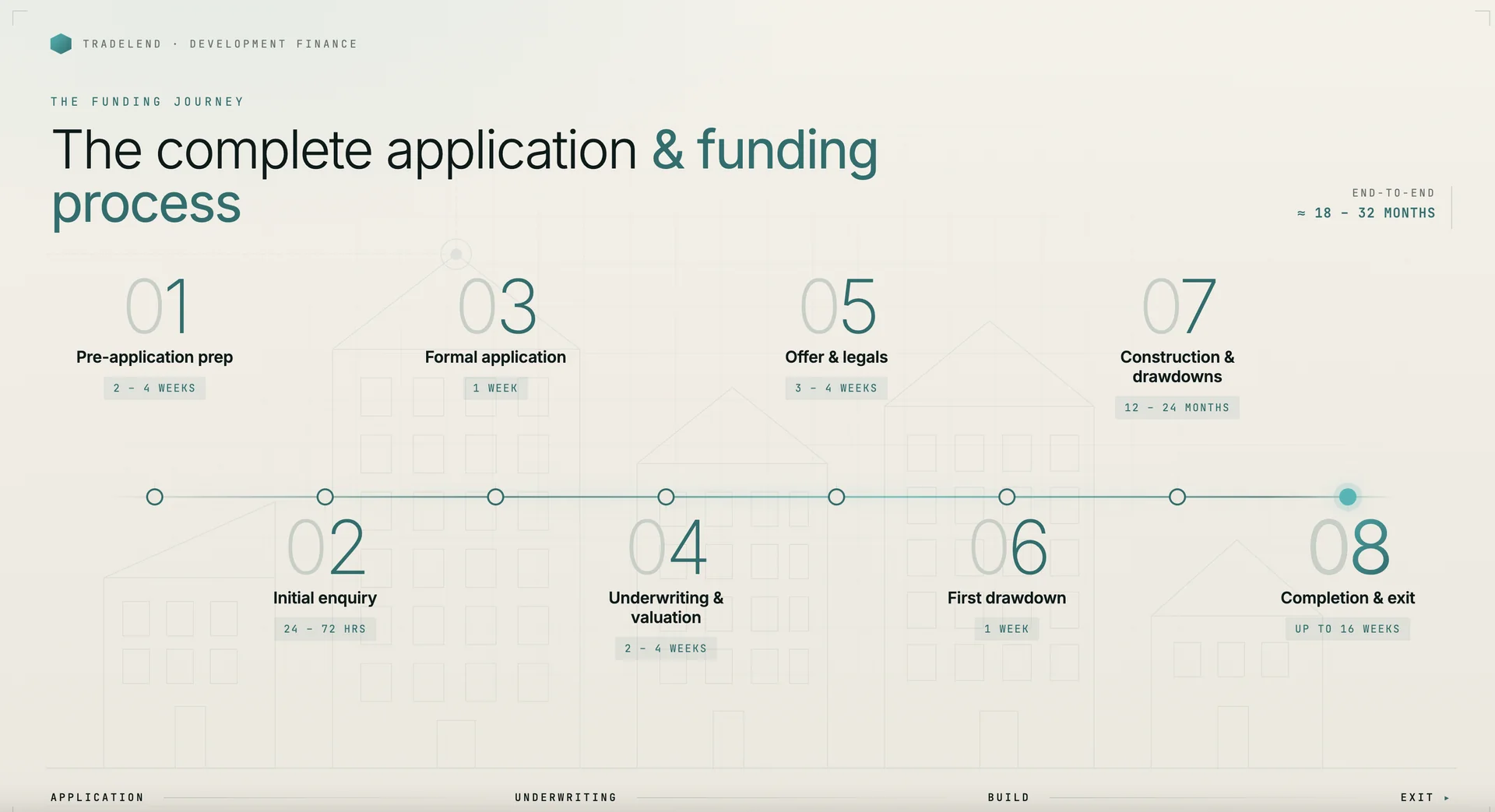
Stage 1: Pre-application preparation (2 to 4 weeks)
Before approaching lenders, gather planning documentation, project costings, development team credentials and financial information.
Stage 2: Initial enquiry and indicative terms (24 to 72 hours)
Submit outline project details to lenders or brokers. Most provide initial feedback within 1 to 3 days.
Stage 3: Formal application submission (1 week)
Complete application packs including full planning permission, detailed cost breakdown, GDV evidence, proof of deposit source and contractor details.
Stage 4: Underwriting and valuation (2 to 4 weeks)
The lender instructs an independent RICS valuation, reviews build cost viability, conducts credit checks and assesses planning risk.
Stage 5: Offer and legal process (3 to 4 weeks)
Formal offer issued, legal documentation prepared, solicitors exchange contracts on land purchase.
Stage 6: Completion and first drawdown (1 week)
Land purchase completes, first charge registered, initial advance released. Monitoring surveyor appointed.
Stage 7: Construction and staged drawdowns (12 to 24 months)
Ongoing cycle of drawdown requests, surveyor inspections, certification and fund release.
Stage 8: Practical completion and exit (up to 16 weeks)
Final inspection, warranty issued, sales complete or refinance approved, development loan repaid.
Total timeline from application to funding: typically 6 to 10 weeks. Total project timeline including construction: usually 18 to 30 months.
Residential development finance
Best for houses, apartments, flats and townhouses built for sale or rental. Higher LTV ratios are available (up to 70% GDV in some cases). Exit is usually via individual unit sales or portfolio refinance.
Commercial development finance
Best for offices, retail units, industrial buildings and mixed-use schemes. Typically lower LTV (60% GDV maximum) with higher deposit requirements (often 30% to 40% of costs).
Senior debt vs. mezzanine finance
Senior debt (first charge): Lower interest rates (7% to 10%), up to 65% to 70% LTV, first charge on security
Mezzanine finance (second charge): Higher interest rates (12% to 20%), additional 10% to 20% LTV on top of senior debt, bridges the funding gap for lower-deposit projects
Development finance vs. bridging loans
Purpose: Development finance funds ground-up construction; bridging funds property purchase or refurbishment
Term: Development 12 to 24 months vs. bridging 1 to 18 months
Funding release: Staged drawdowns vs. lump sum upfront
Build cost coverage: 100% of construction vs. not applicable
LTV: Up to 65% to 70% GDV vs. up to 75% of property value
Monitoring: Mandatory surveyor inspections vs. case by case
Best for: New builds from scratch vs. quick purchases or heavy refurb
Development finance vs. refurbishment finance
Purpose: Development funds ground-up new builds; refurbishment improves existing buildings
Structure: Development supports land plus full construction; refurbishment funds renovation only
Term: Development 12 to 24 months vs. refurbishment 6 to 18 months
Complexity: Higher (new structure) vs. lower (existing building)
Monitoring: Comprehensive surveyor oversight vs. standard inspection
Experience requirements
Lenders typically expect at least one completed development project of similar scale, extensive construction or contracting experience with residential delivery, or partnering with an experienced developer who provides a joint guarantee.
First-time developers: some specialist lenders offer products with lower LTV (55% to 60% GDV), higher deposits (35% to 40%) and a requirement for an experienced contractor with strong references.
Financial requirements
Deposit: minimum 30% to 35% of land cost, or 15% to 20% of total development costs
Credit history: satisfactory personal and business credit required
Proof of funds: bank statements, sale completions or investor commitment letters
Project requirements
Full planning permission strongly preferred
Project must demonstrate minimum 20% profit margin after all costs
Professional team: ARB-registered architect, insured contractor, chartered engineer
NHBC, Premier Guarantee, LABC or equivalent new-build warranty essential
Planning delays and condition discharge
Discharge conditions before land purchase where possible. Build time contingency into the project programme (add 2 to 4 months buffer) and budget additional finance costs for potential extensions.
Build cost overruns
Include 10% to 15% contingency in the cost plan. Obtain a fixed-price contract with the main contractor where possible. Conduct thorough site surveys and protect against inflation with material price locks.
Contractor failure or quality issues
Comprehensive contractor due diligence (references, financial checks, site visits). Ensure adequate insurance and include retention clauses in contractor agreements (typically 5% held back).
Market changes during construction
Build a GDV buffer into viability using conservative comparables. Target strong, proven markets. Pre-sell units where possible to lock in prices.
Project timeline extensions
Set a realistic construction programme from an experienced contractor. Build a 3 to 6 month time buffer into the loan term. Understand the lender’s extension policy and costs upfront.
Project overview
Site: 0.25-acre plot with full planning permission for four 3-bedroom semi-detached houses in an established residential area with strong local demand (average house price £350,000). Developer has three similar completed schemes.
Project costs breakdown
Land purchase: £350,000
Build costs (£100,000 per unit × 4): £400,000
Professional fees (architect, engineer, planning): £25,000
Statutory fees (Building Control, CIL, utilities): £18,000
Contingency (10%): £40,000
Finance costs (rolled interest and fees): £140,000
Marketing and sales: £12,000
Legal costs (purchase, sales, lender): £8,000
Warranty provider (NHBC): £6,000
Insurance (site, contractor, professional): £4,000
Utilities and site setup: £7,000
Total development costs: £1,010,000
Loan structure calculation
65% of £1,400,000 GDV: £910,000
85% of £1,010,000 costs: £858,500
Maximum loan: £858,500 (lower of the two)
Required deposit: £151,500 (15% of total costs)
Drawdown schedule
Month 0 — Land purchase: £227,500 released (cumulative £227,500)
Month 2 — Foundations: £60,000 (cumulative £287,500)
Month 5 — Ground floor and first fix: £100,000 (cumulative £387,500)
Month 8 — First floor and roof structure: £120,000 (cumulative £507,500)
Month 11 — Roof completion, weatherproof, windows: £100,000 (cumulative £607,500)
Month 14 — Second fix, internal finishes: £90,000 (cumulative £697,500)
Month 16 — Practical completion: £50,000 (cumulative £747,500)
Contingency (as needed): £111,000 (cumulative £858,500)
Finance costs detail
Facility amount: £858,500
Interest rate: 9.0% per annum
Term: 18 months
Rolled interest (£858,500 × 9% × 1.5 years): £115,898
Arrangement fee (1.5% of facility): £12,878
Monitoring surveyor (6 visits @ £400): £2,400
Valuation (RICS Red Book): £2,000
Lender legal: £2,500
Exit fee: £0
Total finance costs: £135,676
Exit and profit calculation
Gross sales proceeds (4 × £350,000): £1,400,000
Less sales costs (agent fees, legal): –£24,000
Less loan repayment (capital plus rolled interest): –£974,398
Less initial deposit: –£151,500
Net profit: £250,102
Profit margin (% of GDV): 17.9%
Return on capital invested (£151,500): 165%
Total project duration: 20 months from land purchase to final exit. This example demonstrates realistic returns accounting for all costs, professional oversight and market-standard finance terms.
Next steps: discussing your development finance needs
Key considerations before applying
Project viability must be robust: minimum 20% profit margin, realistic GDV supported by comparables, accurate build costs verified by a quantity surveyor, and proven demand through sales evidence
Team credentials are critical: lenders assess your track record, contractor strength (financial stability, experience, insurance) and the professional team’s qualifications
Planning security reduces risk: full planning permission with manageable conditions provides higher LTV, lower rates, faster approval and greater lender confidence
Exit strategy must be credible: clear evidence of exit viability through comparable sales, agent appraisals, pre-sale agreements, rental yields or tenant demand
Cash flow and contingency are essential: beyond deposit, maintain reserves for cost overruns, timing buffers for delays and personal liquidity for unexpected costs
Ready to move forward?
Property development finance provides the structured funding, professional oversight and flexible exit options that make ground-up construction viable for experienced developers and builders. Speak to experienced lenders who understand short-term construction finance to discuss your project. Get in touch with Tradelend to talk through your scheme.
Frequently asked questions
How long does it take to get development finance approved?
From initial application to funding release typically takes 6 to 10 weeks. Complex projects can extend timelines to 12 to 16 weeks.
Can I get development finance without previous experience?
Yes, but with restrictions. First-time developers typically face lower LTV (55% to 60% GDV), higher deposits (35% to 40%), and a requirement for an experienced contractor with strong references.
What happens if my project runs over budget or timeline?
Contingency funds (10% to 15% of build costs) provide the initial buffer. If exhausted, borrowers must inject additional equity. Most lenders offer 3 to 6 month extensions with additional interest (0.5% to 1% extension fee).
Do I need full planning permission before applying?
Strongly recommended. Full planning maximises LTV (up to 65% to 70% GDV), reduces interest rates and speeds approval. Outline permission or pending applications reduce LTV to 50% to 60% with a 2% to 3% rate premium.
How is interest charged?
Most commonly rolled up: interest compounds monthly and is repaid at exit, preserving cash flow during the build. Alternatively, serviced interest is paid monthly from your own funds, keeping the loan balance fixed.
What deposit do I need?
Standard requirement: 30% to 35% of land purchase price, which typically represents approximately 15% to 20% of total development costs.
Can I use development finance for commercial projects?
Yes. Key differences: lower LTV (typically 60% GDV maximum), higher deposits (30% to 40%), and a requirement for tenant demand evidence or pre-lets.
How do I exit a development finance loan?
Primary routes: sale of completed units, refinance to a long-term mortgage (buy-to-let or commercial), or onward sale to an investor.
What insurance and warranties are required?
A new-build warranty (NHBC, Premier Guarantee or equivalent), contractor PI and public liability insurance, and site and contract works insurance are all mandatory.